Nominations Now Open!
The New Jersey Chapter of the American Planning Association (APA New Jersey) is accepting nominations for the 2025 Planning Excellence Awards & Great Places in New Jersey, but the deadline is fast approaching—don’t miss your chance to submit!
Each year, we celebrate the visionaries, changemakers, projects, and places that are shaping the future of our state. From transformative plans and community initiatives to inspiring leaders and beloved public spaces, these awards spotlight the very best of planning and design in New Jersey.
Honorees will be recognized with a prestigious award plaque, a feature story on APA New Jersey’s website, and special highlights in press releases, newsletters, and social media. Their achievements will also be celebrated at our Awards Reception this December.
Don’t miss the chance to showcase the people, projects, and places that deserve to shine. Submit your nomination today and help us honor New Jersey’s finest in planning!
PLANNING EXCELLENCE AWARDS
The Planning Excellence Awards celebrate individuals, organizations, projects, and initiatives shaping the future of New Jersey through visionary planning and design. Honoring innovation, leadership, and impact, these awards spotlight transformative contributions that strengthen communities, advance equity, and inspire sustainable, resilient growth across the state.
| Download Guidelines | Submit Your Nomination |
Leadership Awards
Budd Chavooshian Award for Outstanding Professional Planner
To a professional planner for sustained contributions to the profession through distinguished practice, teaching, or writing.
Distinguished Civic Leadership Award
To an elected official or citizen planning advocate who has advanced sound planning in the public arena. A citizen planning advocate can be a lay member of a planning board, board of adjustment, economic development board, other appointed official, activist, neighborhood leader, or head of a community development organization.
Distinguished Emerging Planner Award
To a professional planner, 35 years or younger, who has demonstrated extraordinary commitment to leadership, professional development, and the advancement of the field of planning in New Jersey.
Stuart Meck Distinguished Service Award
To an APA New Jersey member who has advanced the mission of the Chapter by consistently and freely giving of themselves to the Executive Committee or Chapter initiatives.
James W. Hughes Applied Research Award
To an individual or organization whose applied research has affected change in New Jersey, as the substantive basis for legislative, regulatory, or policy change, or as the driver of a shift in a fundamental approach to planning.
Project Awards
Outstanding Plan Award
To a plan of unusually high merit. Examples include, but are not limited to neighborhood, economic development, conservation, transportation, and other comprehensive plans. Technical reports and site plans are not eligible for this award.
Outstanding Implementation Award
To a specific planning project or initiative of unusually high merit for which there are demonstrated “on-the-ground” results and success stories that are supported by documented physical or social change.
Outstanding Community Engagement or Education Award
To a planning project or initiative that has involved or resulted in a significant advancement of community comprehension of planning issues or outcomes. Examples may include publications, interactive project websites, public planning and design charrettes, or seminars.
Outstanding Student Project Award
To outstanding class projects or papers by a student or group of students that contribute to advances in the field of planning. The submission should be primarily the work of the students and based in New Jersey. The students may be from any secondary education institution.
GREAT PLACES IN NEW JERSEY
Great Places offer better choices for where and how people work and live. They are enjoyable, safe, and desirable. New Jersey’s great downtowns, public spaces, streets, and neighborhoods are defined by many criteria, including architectural features, accessibility, functionality, and community activity. Since 2012, the APA New Jersey Awards Jury has designated 56 locations throughout the state, all of which are featured on our Great Places in New Jersey website.
| Download Guidelines | Submit Your Nomination |
Award Categories
Great Downtown
A downtown is the business district of the community. It generally provides various uses, including, but not necessarily limited to, retail stores, offices, government buildings, theaters, housing, parking facilities, public spaces, and other features that draw residents and visitors.
Great Public Space
A public space may be a gathering spot or part of a neighborhood, downtown, special district, waterfront, or another area within the public realm that helps promote social interaction and a sense of community. Examples include plazas, town squares, parks, marketplaces, public commons and malls, public greens, piers, special areas within convention centers or grounds, sites within public buildings, concourses, or public spaces within private buildings.
Great Street
A street comprises a three-dimensional visual corridor, including how it relates to the adjacent development. Submissions should document the street’s character, form, and function. Streets of different types are eligible, ranging from pedestrian to arterial roadways, but each should have definable characteristics. Emphasis is placed on streets that service and consider all users —auto, pedestrian, bicycle, or transit riders.
Great Neighborhood
A neighborhood is a geographic unit within the municipality typically bordered by significant physical features, either natural or manufactured. Residents share the use of public facilities such as schools and shopping areas that facilitate social interactions. The neighborhood may be known by a commonly recognized name. Neighborhoods within municipalities of different types are eligible for nomination: downtown, urban, suburban, exurban, town, or small village.
Characteristics of Great Places in New Jersey
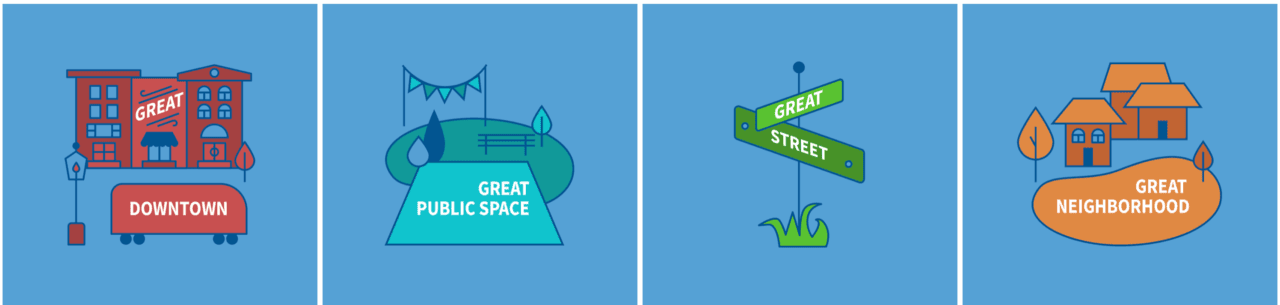
A downtown is the business district of the community. It generally provides various uses, including, but not necessarily limited to, retail stores, offices, government buildings, theaters, housing, parking facilities, public spaces, and other features that draw residents and visitors.
Characteristics of a Great Downtown include:
- Functions as the centerpiece in the everyday life of the community. It offers an array of places where people come to conduct business, meet their daily needs, go shopping, meet friends, and relax.
- Enjoys a reputation for excellence that reaches well beyond the community’s boundaries. It attracts visitors from a distance that reflects its physical size.
- Possesses tremendous vitality, with lots of people not just during the day but also in the evening and on the weekends.
- Offers special events and attractions throughout the year.
- Provides accessible transportation, walkability, parking, and parking alternatives.
- Receives support from the community to attract, retain, and grow businesses. Examples: “Buy Local” campaigns and façade improvement programs.
A public space may be a gathering spot or part of a neighborhood, downtown, special district, waterfront, or another area within the public realm that helps promote social interaction and a sense of community. Examples include plazas, town squares, parks, marketplaces, public commons and malls, public greens, piers, special areas within convention centers or grounds, sites within public buildings, concourses, or public spaces within private buildings.
Characteristics of a Great Public Space include:
- Offers high-quality attractions and amenities.
- It promotes social activity and creates a sense of community and neighborliness.
- It is safe, welcoming, and accommodating for all users. Encourages use and interaction among a diverse cross-section of the public.
- It has a unique character that makes it extraordinary or memorable.
- Has design and architectural features that are visually interesting.
- Reflects the local culture or history.
- Relates well to surrounding areas and uses.
A street comprises a three-dimensional visual corridor, including how it relates to the adjacent development. Submissions should document the street’s character, form, and function. Streets of different types are eligible, ranging from pedestrian to arterial roadways, but each should have definable characteristics. Emphasis is placed on streets that service and consider all users —auto, pedestrian, bicycle, or transit riders.
Characteristics of a Great Street include:
- Balances the competing needs of the street — driving, transit, walking, cycling, servicing, parking, drop-offs, etc. with that of adjoining land uses.
- Capitalizes on natural features and the context in which it resides.
- Creates an atmosphere using design and architectural features. Such features should reflect the local culture or history.
- Encourages social activities such as festivals, parades, and open-air markets.
- Employs hardscape, landscape, street furniture, or other physical elements to create ambiance and atmosphere.
- Promotes safety of pedestrians and vehicles and promotes use over the 24-hour day.
- It is well maintained and capable of being maintained without excessive costs.
- Has a memorable character.
- To the extent feasible, it promotes sustainability through minimizing runoff, reusing water, ensuring groundwater quality, minimizing heat islands, and responding to climatic demands.
A neighborhood is a geographic unit within the municipality typically bordered by significant physical features, either natural or manufactured. Residents share the use of public facilities such as schools and shopping areas that facilitate social interactions. The neighborhood may be known by a commonly recognized name. Neighborhoods within municipalities of different types are eligible for nomination: downtown, urban, suburban, exurban, town, or small village.
Characteristics of a Great Neighborhood include:
- It has a memorable character that reflects the community’s overall personality and local history but sets itself apart from other neighborhoods.
- Design and architectural features are visually attractive. Older neighborhoods have retained their historic charm.
- It has a variety of functional attributes that contribute to a resident’s day-to-day living (i.e., residential, commercial, or mixed-uses).
- Accommodates a variety of modes of transportation (i.e., pedestrians, bicycles, cars) and provides access to multiple destinations that serve its residents.
- Encourages social activity and creates a sense of community and neighborliness.
- Provides and maintains a safe, secure environment (e.g., traffic calming, neighborhood watch organization, Safe Routes to School program).
- Promotes sustainability and responds to climatic demands.